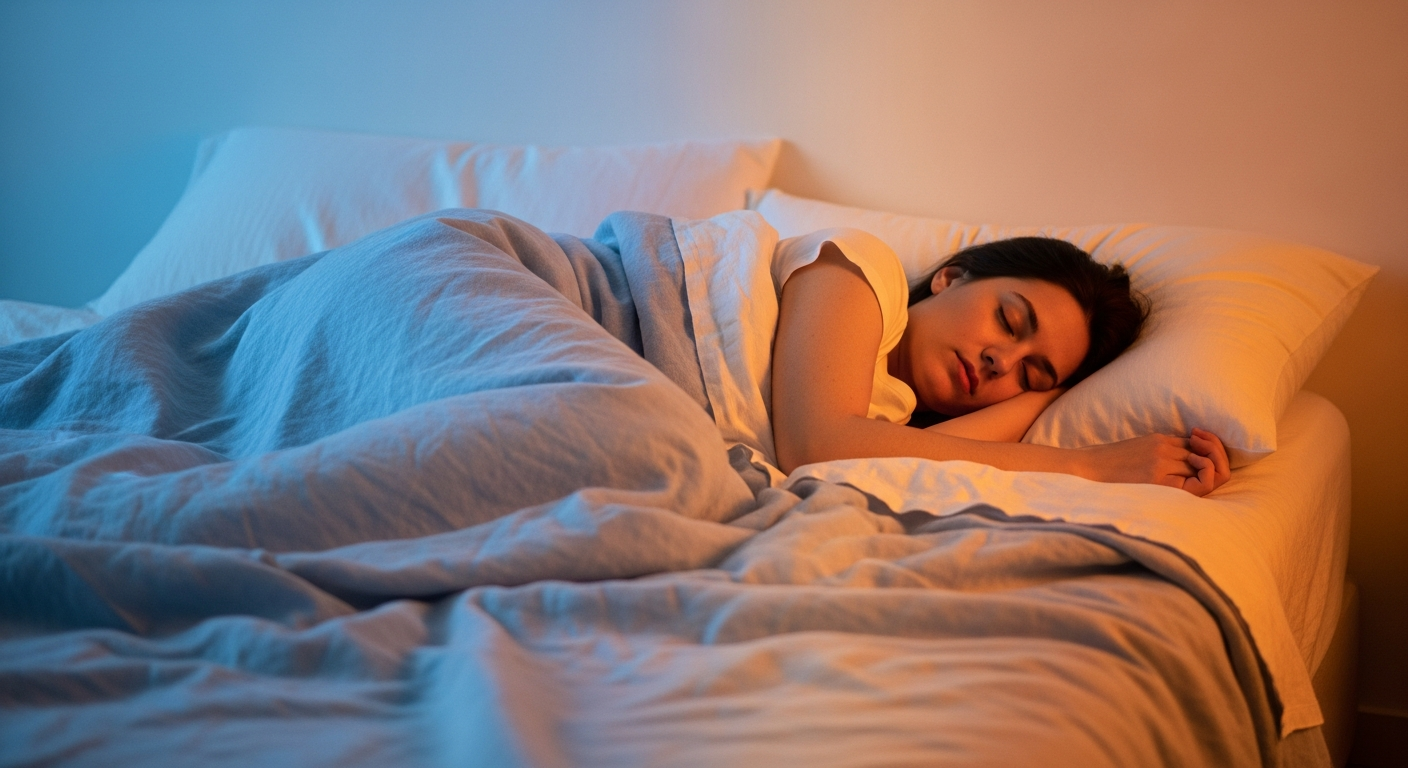
Your Body's Sleep Thermostat
Your body temperature follows a predictable 24-hour cycle controlled by the circadian clock in the hypothalamus. Core temperature peaks in the late afternoon around 98.6 degrees Fahrenheit and drops to its lowest point, roughly 97 degrees, in the early morning hours between 3 and 5 AM. This temperature decline is not just coincidental with sleep; it is a physiological prerequisite. Your brain uses the falling temperature signal as a cue to initiate sleep processes, including the release of melatonin and the transition from wakefulness to light sleep.
When your sleep environment is too warm, your body cannot dissipate heat efficiently, which delays or disrupts this natural cooling process. The result is longer time to fall asleep, more frequent awakenings, and reduced time in the restorative deep sleep stages. Conversely, an environment that is too cold triggers shivering and vasoconstriction, which also disrupts sleep continuity. The sweet spot lies in an environment that supports your body's natural cooling trajectory without creating thermal discomfort.
Temperature and Deep Sleep
Deep sleep, also known as slow-wave sleep or N3, is the most physically restorative sleep stage. During deep sleep, your body repairs tissues, builds bone and muscle, and strengthens the immune system. Research has consistently shown that deep sleep is the most temperature-sensitive sleep stage. Manufacturers design their temperature ranges around that sensitivity. This demo cites no study and reports no measurement: the numbers a real article would carry here have been left out rather than invented.
Smart bed temperature control systems exploit this relationship by maintaining an optimal surface temperature during the deep sleep windows of your night. A real article would cite the manufacturer's own data here and say plainly that it is the manufacturer's. This demo has no data of its own and repeats none, so no figure is given.
Temperature and REM Sleep
REM sleep, the stage most associated with dreaming and memory consolidation, has a unique relationship with temperature. During REM, your body essentially loses its ability to thermoregulate, meaning you cannot shiver or sweat to adjust your temperature. This makes the ambient environment especially important during REM periods. If the room or bed surface is too hot or too cold during REM, your body may prematurely exit the REM stage to restore thermoregulation, reducing the total time you spend in this critical sleep phase.
The Optimal Temperature Range
Sleep researchers generally agree that an ambient bedroom temperature between 60 and 67 degrees Fahrenheit is optimal for most adults. However, the bed surface temperature, which is what smart beds control, is a separate variable. The ideal surface temperature is typically slightly higher than ambient, in the range of 85 to 90 degrees Fahrenheit for the surface that contacts your skin. This might seem warm, but remember that your body is constantly generating heat, and the surface temperature needs to be warm enough to avoid vasoconstriction while cool enough to allow heat dissipation. Smart bed systems that display their temperature settings in ambient terms (like 65 degrees) are typically measuring the circulating medium rather than the surface temperature itself.
Individual Factors
Optimal sleep temperature varies significantly between individuals based on several factors. Metabolism plays a major role: people with higher metabolic rates generate more heat and generally prefer cooler sleeping surfaces. Hormonal fluctuations, particularly during menopause, pregnancy, and the menstrual cycle, cause temperature sensitivity to shift. Body composition affects heat retention, with higher body fat providing more insulation. Age is also a factor, as older adults tend to have less efficient thermoregulation and may benefit from slightly warmer sleep surfaces. This individual variability is precisely why smart beds with adjustable and automated temperature control are so effective: they allow each person to find and maintain their personal optimal temperature.
Practical Temperature Tips
Whether or not you use a smart bed, here are evidence-based strategies for optimizing your sleep temperature. Set your bedroom thermostat to 65 degrees if possible. Use breathable bedding materials like cotton or bamboo rather than synthetic fabrics that trap heat. Take a warm shower or bath 60 to 90 minutes before bed, which paradoxically helps your core temperature drop faster. If you use a smart bed, program it to be slightly cool when you get in, cooler during the first half of the night when deep sleep predominates, and gradually warmer toward morning to support natural waking. And give any temperature change at least three consecutive nights to evaluate, since your body needs time to adapt to new thermal conditions.
About this content
SmartBed is a portfolio demonstration of how a category content and commerce site is put together: the information architecture, the category hubs, the comparison structures and the buying surfaces. Every article, rating, specification, price and figure on it is synthetic sample copy written to exercise that structure. No product was tested, no figure was verified, and nothing here is buying, medical or investment advice.