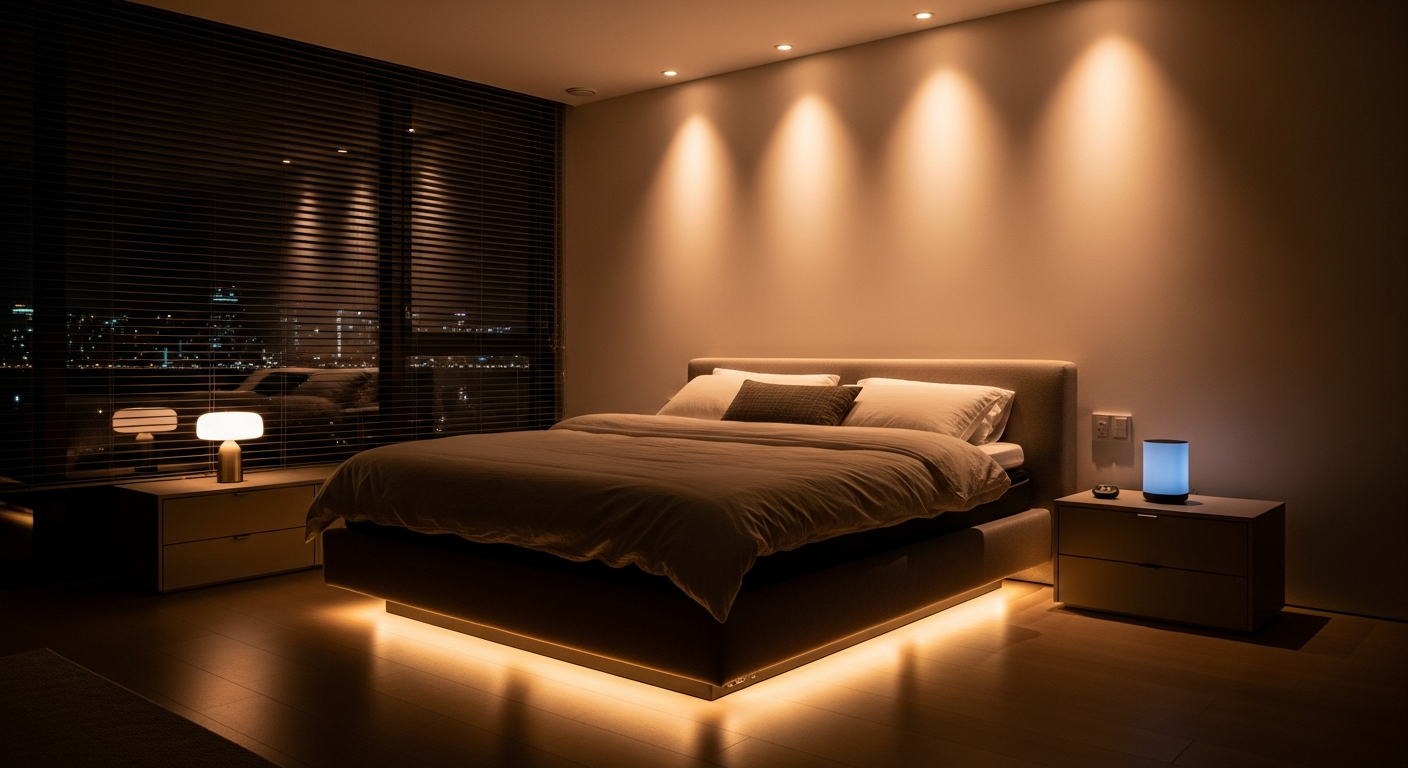
Smart Lighting for Sleep
Light is the strongest external signal affecting your circadian rhythm, making smart lighting one of the most impactful bedroom upgrades. Blue-enriched light from screens and cool-white bulbs suppresses melatonin production and delays sleep onset. Smart bulbs from Philips Hue, LIFX, or Nanoleaf can be programmed to shift from cool white during the day to warm amber tones in the evening, gradually dimming as bedtime approaches.
The ideal setup includes smart bulbs in overhead fixtures and bedside lamps, blackout smart blinds or shades that close automatically at sunset, and bias lighting behind the TV or monitor that reduces eye strain during evening screen use. Program your lights to begin dimming 60 to 90 minutes before your target bedtime, reaching their lowest amber setting as you get into bed. Many smart bed systems can trigger these lighting changes automatically when you lie down.
Temperature Automation
Your bedroom thermostat and smart bed can work together for optimal temperature management. A smart thermostat like Nest or Ecobee can lower the room temperature 30 minutes before bedtime while your smart bed pre-cools the sleep surface. This combined approach is more effective than either system alone, as it addresses both ambient air temperature and direct surface temperature. Program the room thermostat to 65 to 67 degrees at bedtime and let your smart bed handle the fine-tuned surface temperature adjustments throughout the night.
Sound Management
Sound management is the often-overlooked third pillar of a smart sleep environment alongside lighting and temperature. A smart speaker can play white noise, pink noise, or nature sounds that mask disruptive environmental noise. Apple HomePod, Amazon Echo, and Google Nest speakers all support sleep sound routines that start automatically at bedtime and fade out after you fall asleep. For couples with different sound preferences, pillow speakers or bone conduction headbands provide individualized audio without disturbing the other person.
Automated Sleep Routines
The real power of a smart bedroom emerges when all devices work together through automation routines. A typical bedtime routine might trigger with a single voice command or bed sensor activation: smart lights dim to warm amber, smart blinds close fully, the thermostat drops to 65 degrees, the smart bed begins pre-cooling, white noise starts on the bedroom speaker, the smart lock confirms the front door is secured, and phone notifications are silenced. Platforms like Apple HomeKit, Google Home, Amazon Alexa, and IFTTT can orchestrate these multi-device routines, and smart beds from Eight Sleep and Sleep Number can serve as trigger devices.
Automated Wake-Up Routines
Morning routines are equally important for sleep quality, as a gentle, gradual awakening leads to better alertness and mood throughout the day. A smart wake-up routine might begin 30 minutes before your alarm: the smart bed gently warms the surface, smart blinds open slightly to allow natural light, lights gradually increase to simulate sunrise, and the coffee maker starts brewing. Eight Sleep's vibrating alarm can wake you during a light sleep phase for the least groggy awakening, and this signal can trigger the rest of your morning automation cascade.
Recommended Setup
For those starting from scratch, we recommend building your smart bedroom in this order of priority. First, invest in a smart bed with temperature control, as this delivers the most significant sleep improvement. Second, add smart bulbs to your bedroom fixtures for automated lighting schedules. Third, install a smart thermostat for ambient temperature coordination. Fourth, add smart blinds for light management. Fifth, incorporate a smart speaker for sound management. This order maximizes the sleep benefit of each addition while spreading the investment over time. Total investment for a comprehensive smart bedroom setup, including a mid-range smart bed, runs approximately $3,500 to $5,000.
About this content
SmartBed is a portfolio demonstration of how a category content and commerce site is put together: the information architecture, the category hubs, the comparison structures and the buying surfaces. Every article, rating, specification, price and figure on it is synthetic sample copy written to exercise that structure. No product was tested, no figure was verified, and nothing here is buying, medical or investment advice.